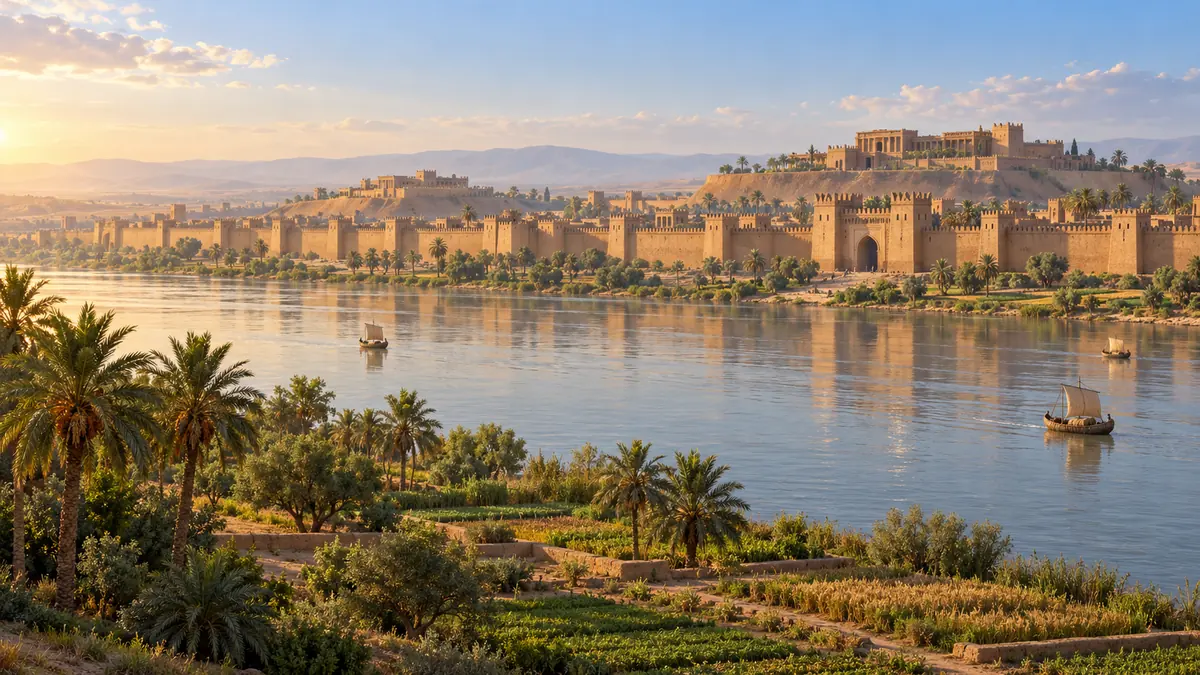
Nineveh was a great city of Assyria, the empire centered in what is now northern Iraq. Its ruins lie on the east bank of the Tigris River at Mosul, 410 km (about 255 miles) north of Baghdad by Iraq’s entry on UNESCO’s tentative list, and they form two mounds, Kuyunjik and Nebi Yunus. In the Bible it is the city God sent Jonah to warn and the city Nahum and Zephaniah said would fall, and a Babylonian chronicle in the British Museum records its fall in 612 BC.
Start each morning in the Word
Get the free 7-day reading plan, then one short devotional each morning.
The ruins are two mounds on the Tigris’s east bank
Michael Chan, writing for the Society of Biblical Literature’s Bible Odyssey site, says the remains sit “along the eastern bank of the Tigris River across from modern day Mosul in northern Iraq.” The site’s map page says “in the modern-day city of Mosul,” and a 2017 University of Hamburg report speaks of “the eastern Mosul zone that includes the two tells” (a tell is a mound built up from layers of ruins). The wording differs, but the place is the same: the mounds are on the east bank, and the modern city reaches around them. National Geographic in 2016 called Mosul the city “that surrounds Nineveh.”
Livius, Jona Lendering’s ancient history site, says the small Khosr river “divides the town into a northern and a southern half.” Kuyunjik is the northern hill. The southern one is Nebi Yunus (“prophet Jonah”), named “after the old Islamic mausoleum on that site.” Iraq’s UNESCO entry says that mound is covered with houses around a mosque “containing the reputed tomb of Jonah.” CNN reported in 2014 that “biblical scholars are divided” on whether the tomb was Jonah’s, and that in Jewish tradition he went home to Gath-hepher.
Nineveh appears in 19 verses across 8 books
By our count of the ESV text, 19 verses name Nineveh. Bible Gateway’s ESV search returns 23 hits, but four (Jonah 3:1; Nahum 1:2, 2:1 and 3:1) match only section headings.
| Where (ESV) | A short phrase | What it says |
|---|---|---|
| Genesis 10:11 and 10:12 | ”built Nineveh, Rehoboth-Ir, Calah” | The founding, after the list of Nimrod’s cities. Verse 12 ends “that is the great city”. |
| 2 Kings 19:36 and Isaiah 37:37 | ”went home and lived at Nineveh” | Sennacherib’s home after his campaign against Judah. |
| Jonah 1:2 | ”go to Nineveh, that great city” | God’s first call to Jonah. |
| Jonah 3:2 and 3:3 | ”an exceedingly great city” | The second call, then the city’s size. |
| Jonah 3:4 | ”Yet forty days, and Nineveh shall be overthrown!” | Jonah’s message. |
| Jonah 3:5 and 3:6 | ”the people of Nineveh believed God” | The city responds, and the word reaches the king. |
| Jonah 3:7 | ”published through Nineveh” | The king’s decree goes out across the city. |
| Jonah 4:11 | ”should not I pity Nineveh, that great city” | God’s closing question. |
| Nahum 1:1, 2:8 and 3:7 | ”An oracle concerning Nineveh” | The book is headed as an oracle about the city. |
| Zephaniah 2:13 | ”he will make Nineveh a desolation” | A word against Assyria and its city. |
| Matthew 12:41, Luke 11:30 and 11:32 | ”The men of Nineveh will rise up at the judgment” | Jesus points back to Jonah’s Nineveh. |
A KJV search finds 17, because the KJV reads “Ninevites” in Luke 11:30 and “Nineve” in 11:32. Tobit, which is in Catholic and Orthodox Bibles but not Protestant or Jewish ones, also names the city (Tobit 1:3; 14:4).
Genesis 10:11 has a translation split. The ESV, NIV, NASB, CSB and NRSVue say “he” (Nimrod, named in verses 8 to 10) went into Assyria and built Nineveh. The KJV reads “Out of that land went forth Asshur, and builded Nineveh”.
In Jonah, Nineveh is “that great city” that listens
The book opens with God’s command: “Arise, go to Nineveh, that great city, and call out against it, for their evil has come up before me” (Jonah 1:2, ESV). Jonah’s first answer is to run. He “went down to Joppa and found a ship going to Tarshish” (Jonah 1:3). 2 Kings 14:25 places “Jonah the son of Amittai, the prophet, who was from Gath-hepher,” in the reign of Jeroboam II. In the story, Nineveh is a great Assyrian city; UNESCO’s entry dates its time as the Assyrian capital from about 700 BC, under Sennacherib.
Sent a second time, Jonah calls out “Yet forty days, and Nineveh shall be overthrown!” (Jonah 3:4). The people fast, the king puts on sackcloth, and “God relented of the disaster that he had said he would do to them, and he did not do it” (Jonah 3:10). Then Jonah complains that he knew God is “a gracious God and merciful, slow to anger and abounding in steadfast love” (Jonah 4:2), a line the devotional on Jonah 4:2 reads on its own.
Jonah 3:3 says Nineveh was “a great city to God” in the Hebrew
The ESV reads “Now Nineveh was an exceedingly great city, three days’ journey in breadth” (Jonah 3:3), with a footnote on the first half: “Hebrew a great city to God”. Sefaria’s text of the Masoretic Hebrew has עִיר־גְּדוֹלָה֙ לֵֽאלֹהִ֔ים (‘ir gedolah le’lohim). Here is how eight versions handle it (NIV vs ESV vs KJV explains why their approaches differ).
| Version | Jonah 3:3 | Footnote on Bible Gateway |
|---|---|---|
| ESV | ”an exceedingly great city" | "Hebrew a great city to God” |
| KJV | ”an exceeding great city of three days’ journey” | none |
| NASB | ”an exceedingly large city, a three days’ walk" | "Lit a great city to God” |
| NIV | ”a very large city; it took three days to go through it” | none |
| CSB | ”an extremely great city, a three-day walk" | "Or was a great city to God” |
| NRSVue | ”an exceedingly large city, a three days’ walk across” | none |
| YLT | ”a great city before God, a journey of three days” | none |
| NLT | ”a city so large that it took three days to see it all" | "Hebrew a great city to God, of three days’ journey” |
Commentators split on what “to God” does. One reading hears an idiom for “very.” Radak, the medieval Jewish commentator Rabbi David Kimchi, says that to enlarge something you “juxtapose it with God in a way that increases its size,” as in “the mountains of God” and “the cedars of God”. Ellicott calls it “an expression equivalent to a divinely great city”. Strong’s entry for elohim (H430) says the word is used “sometimes as a superlative,” though that is a general note, not a comment on this verse.
The other reading keeps God in view. Barnes says the city was great “in the judgment of God who cannot be deceived”. Keil and Delitzsch write that “it was regarded by God as a great city” and tie that to Jonah 4:11. Both camps read the same Hebrew and differ on what the phrase does.
”Three days’ journey” is read as a circuit, a visit or not a measurement
| Reading | Held by | What they say |
|---|---|---|
| A circuit of about 60 miles around a greater Nineveh district | Ellicott; the Cambridge Bible | Ellicott: “The circuit of the walls was the most obvious measurement to give of an ancient city.” Cambridge says the area held “fields under tillage and pastures” too. |
| The time it took to visit the city | The ESV’s alternative footnote; the Pulpit Commentary, as its second option | The footnote reads “Or a visit was a three days’ journey”. |
| The city did not take three days to cross | Michael Chan, Bible Odyssey | Chan writes that Nineveh “did not take” three days to cross. |
For scale, Iraq’s UNESCO entry gives the city wall “a circumference of over 12 km,” about 7.5 miles. Converted by us, the 60-mile reading (about 97 km) is roughly eight times that.
The 120,000 are read as children or as the whole city
God’s closing question reads: “And should not I pity Nineveh, that great city, in which there are more than 120,000 persons who do not know their right hand from their left, and also much cattle?” (Jonah 4:11). One reading takes the number as the whole city. Wikipedia’s Nineveh article gives the 120,000 as the population, and the Cambridge Bible describes a view in which the phrase describes the whole population’s “moral condition of heathen ignorance and darkness,” a view Cambridge itself rejects.
The other reading takes the 120,000 as young children. Rashi, in the Judaica Press translation on Sefaria, glosses the phrase as “children,” and the JPS note on Jonah 4:11 says “infants and animals are not held responsible for their actions”. Barnes speaks of “the 120,000 children of Nineveh”, and Jamieson-Fausset-Brown, counting them as a fifth of the city, arrives at 600,000 people. Cambridge, which also reads the phrase as children, warns that working out Nineveh’s population from the verse “must necessarily be precarious”.
The text names violence, lies and pride as Nineveh’s sin
Jonah 1:2 gives only “their evil,” and the ESV footnote says “The same Hebrew word can mean evil or disaster, depending on the context”. The king’s decree is more specific: “Let everyone turn from his evil way and from the violence that is in his hands” (Jonah 3:8). Strong’s defines the Hebrew word for violence there (H2555, chamas) as “violence; by implication, wrong”.
Nahum writes “Woe to the bloody city, all full of lies and plunder” (Nahum 3:1) and ends his book asking “For upon whom has not come your unceasing evil?” (Nahum 3:19). Zephaniah 2:15 calls it “the exultant city that lived securely,” a city that says in its heart there is no one else.
Assyria left its own record. The British Museum holds a relief from the South West Palace at Nineveh (museum number 124911), dated 700 to 692 BC, whose inscription reads “Sennacherib, king of the world, king of Assyria, set up a throne and the booty of Lachish passed before him”. The museum’s description says prisoners “are brought before him and executed”. Chan adds a caution about such scenes: Assyrian palace reliefs were “primarily concerned with demonstrating the king’s legitimacy, piety, and prestige,” not neutral records.
The Assyrians lived in Nineveh, and Sennacherib made it their capital
Iraq’s UNESCO entry says Nineveh “was adopted by the Assyrians as their political seat” and that Sennacherib established it as their capital about 700 BC. Bible Odyssey’s map page gives his reign as 704 to 681 BC.
He is the king who ties Nineveh to Judah’s story. “Sennacherib king of Assyria came up against all the fortified cities of Judah and took them” (2 Kings 18:13), and “Hezekiah king of Judah sent to the king of Assyria at Lachish” (2 Kings 18:14). Chan dates the Lachish campaign to 701 BC. Afterward Sennacherib “went home and lived at Nineveh” (2 Kings 19:36). The devotional on Isaiah 30:15 covers the years when he took the Assyrian throne.
Nineveh fell in 612 BC
Nahum and Zephaniah announce the fall. “Wasted is Nineveh; who will grieve for her?” (Nahum 3:7), and “he will make Nineveh a desolation, a dry waste like the desert” (Zephaniah 2:13). The date comes from British Museum tablet 21901, a Babylonian chronicle for the years 616 to 609 BC that the museum calls “famous for its description of the fall of Nineveh”.
In A. K. Grayson’s translation of that tablet (the Fall of Nineveh Chronicle, ABC 3), as adapted on Livius, the attackers “subjected the city to a heavy siege” for three months and “turned the city into a ruin heap”. The chronicle files this under the Babylonian king’s fourteenth year, and Livius dates the siege from May 612 BC, with the fall in July.
Layard and Rassam dug up Ashurbanipal’s library
The British Museum’s blog post “A library fit for a king” says the English explorer Austen Henry Layard made the first big find of library tablets in 1850, and that “Layard’s Iraqi assistant, Hormuzd Rassam,” found a second palace with more tablets in 1852. The museum counts “over 30,000 clay tablets and fragments” from the library of Ashurbanipal, who ruled from 669 to about 631 BC.
The shrine and gates were hit in 2014 and 2016, and a palace turned up in 2017
Since Iraq filed its UNESCO entry in 2000:
- July 2014. CNN reported on July 24 that ISIS militants planted explosives around Jonah’s tomb and set them off remotely, citing civil defense officials.
- April 2016. National Geographic’s Kristin Romey reported photos that “appear to confirm the destruction of the Mashki and Adad Gates”. A May 5 update says “the Adad Gate, rather than the Nergal Gate, was destroyed, in addition to a large portion of Nineveh’s fortification wall”. The magazine notes the gate was built around 700 BC and reconstructed in the 20th century.
- Undated video. The University of Hamburg report from March 2017 says footage showed jihadists “reducing to rubble” the winged-bull statues at the Nergal gate.
- Early 2017. After Iraqi troops retook eastern Mosul in January, a team led by Layla Salih, a conservator at the Mosul Museum, found tunnels ISIS had dug under the ruined mosque. The Hamburg report says they “led to an Assyrian palace dating from the seventh century BCE which had never before been explored”, with a marble inscription attributed to Esarhaddon (680 to 669 BC).
-
- Peter Miglus, in Zeitschrift für Assyriologie, published a study of relief panels that came out of the looting tunnels in the Late Assyrian military palace on Tell Nebi Yunus.
The newest source here is from 2021. As of October 21, 2026, UNESCO lists Nineveh on Iraq’s tentative list, where it has been since 2000, not on the World Heritage List.
Jesus names the men of Nineveh, so the city is in both testaments
Jesus carries Nineveh from the Old Testament into the Gospels: “The men of Nineveh will rise up at the judgment with this generation and condemn it, for they repented at the preaching of Jonah” (Matthew 12:41). Luke records that “Jonah became a sign to the people of Nineveh” (Luke 11:30).
The book of Jonah itself ends on God’s question, “should not I pity Nineveh, that great city” (Jonah 4:11), and never records Jonah’s answer.
Questions people ask
What is Nineveh called today? The ruins go by their two mounds’ names, Kuyunjik and Nebi Yunus (“prophet Jonah”). They sit on the Tigris’s east bank within Mosul, Iraq, 410 km north of Baghdad by Iraq’s UNESCO entry.
What sin was Nineveh known for? Jonah 1:2 says only that “their evil” had come up before God. The king’s decree names “the violence that is in his hands” (Jonah 3:8), and Nahum cries “Woe to the bloody city, all full of lies and plunder” (Nahum 3:1).
What nationality were the people of Nineveh? Nineveh was an Assyrian city. Iraq’s UNESCO entry says it “was adopted by the Assyrians as their political seat” and that Sennacherib made it their capital about 700 BC. He is the king who attacked Lachish in Judah (2 Kings 18:13-14), in 701 BC by Michael Chan’s date on Bible Odyssey.
Why did Jonah not want to go to Nineveh? Jonah gives his own reason after the city is spared: “That is why I made haste to flee to Tarshish; for I knew that you are a gracious God and merciful” (Jonah 4:2). The sparing “displeased Jonah exceedingly” (Jonah 4:1), and the book does not explain further why mercy to Nineveh angered him.
What does Jesus say about Nineveh? He says “The men of Nineveh will rise up at the judgment with this generation and condemn it, for they repented at the preaching of Jonah” (Matthew 12:41), and that Jonah “became a sign to the people of Nineveh” (Luke 11:30).
What is left of Nineveh today? Two ruin mounds, Kuyunjik and Nebi Yunus, and what remains of a city wall that Iraq’s UNESCO entry, filed in 2000, measured at over 12 km around. ISIS destroyed Jonah’s shrine in July 2014 (CNN), and in 2016 the Adad Gate and “a large portion of Nineveh’s fortification wall” (National Geographic). In 2017 a team found an unexplored seventh-century BC palace in ISIS tunnels (University of Hamburg).