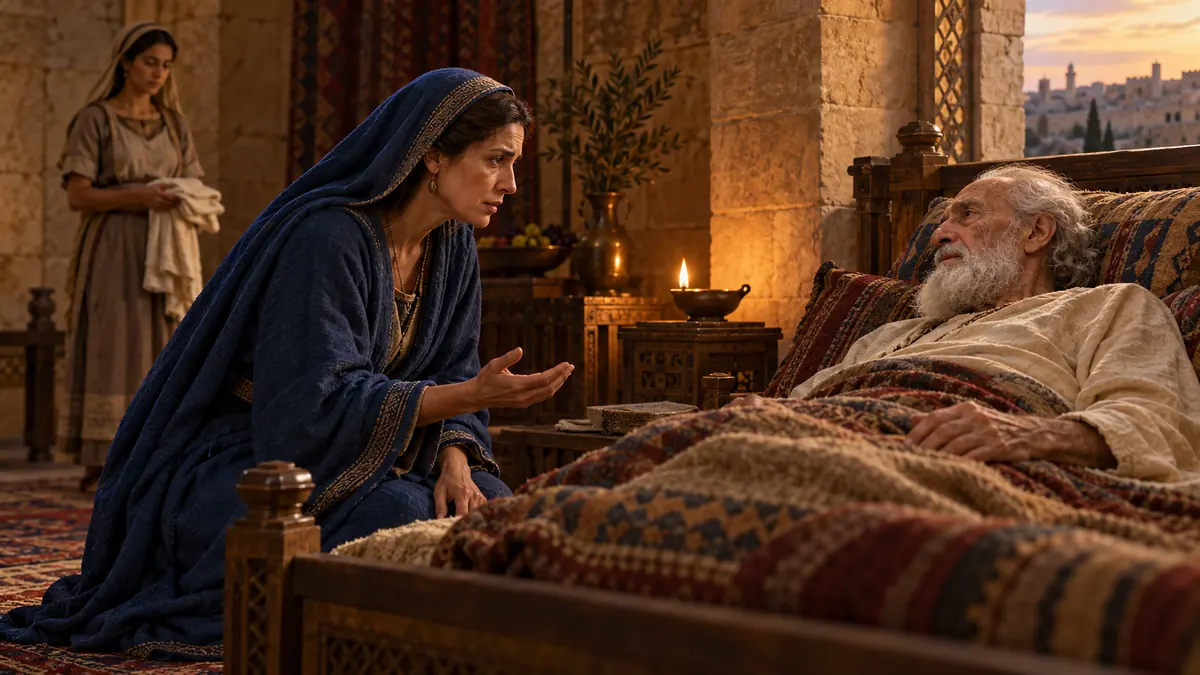
Bathsheba was the wife of Uriah the Hittite, then the wife of King David, and the mother of King Solomon. Her story starts in 2 Samuel 11, where David sees her from his roof, sleeps with her, and arranges her husband’s death. It ends in 1 Kings 1-2, where she helps put Solomon on the throne and sits at his right hand as the king’s mother.
Someone tells David who she is in the first scene: “Is not this Bathsheba, the daughter of Eliam, the wife of Uriah the Hittite?” (2 Samuel 11:3, ESV). The rooftop scene is only the first half.
Start each morning in the Word
Get the free 7-day reading plan, then one short devotional each morning.
What happened between David and Bathsheba?
It was spring, “the time when kings go out to battle.” David sent Joab and the army to besiege the Ammonite city of Rabbah, “But David remained at Jerusalem” (2 Samuel 11:1). Late one afternoon he walked on the palace roof and saw a woman bathing, and “the woman was very beautiful” (11:2). He asked who she was. Then comes the verse readers still argue about:
“So David sent messengers and took her, and she came to him, and he lay with her. (Now she had been purifying herself from her uncleanness.) Then she returned to her house.” (2 Samuel 11:4, ESV)
Her only recorded words in the chapter are a message sent to the king: “I am pregnant” (11:5).
David tried to cover it. He called her husband home from the front and told him, “Go down to your house.” Uriah was one of David’s mighty men, the elite warriors listed in 2 Samuel 23:39, and he slept at the palace door instead. The ark and the army were out in the field, he said, so how could he go home “to eat and to drink and to lie with my wife?” (11:11). David got him drunk the next night. Uriah still didn’t go home.
So David wrote to Joab and had Uriah carry the letter himself: “Set Uriah in the forefront of the hardest fighting, and then draw back from him, that he may be struck down, and die” (11:15). Uriah died. Joab’s instructions to the messenger even expected David to bring up the woman at Thebez who killed Abimelech with a millstone from the wall (11:20-21), a story from the book of Judges, the same book that tells of Jael. When Bathsheba heard, “she lamented over her husband.” After the mourning, David brought her to his house, “she became his wife and bore him a son,” and the chapter ends: “But the thing that David had done displeased the Lord” (11:26-27).
What the purification note says, in five translations
English Bibles handle the short note in 11:4 in different ways. The Hebrew is a single participle, mitqaddeshet, from the verb for making holy or clean (Bible Hub interlinear). Translations differ on what the washing was and where it falls in the story, and some leave it open:
| Translation | 2 Samuel 11:4 |
|---|---|
| ESV | ”(Now she had been purifying herself from her uncleanness.)” |
| KJV | ”for she was purified from her uncleanness” |
| NIV | ”(Now she was purifying herself from her monthly uncleanness.)” |
| NRSVUE | ”(Now she was purifying herself after her period.)” |
| NASB | ”and when she had purified herself from her uncleanness, she returned to her house” |
The NIV and NRSVUE read it as the end of her monthly period, and the NET’s translator note draws the consequence: since she had just had her period, “Uriah, who has been away fighting, cannot be the father of the child” (NET, Bible Gateway). The NASB instead places the washing after she was with David. Keil and Delitzsch take it that way, pointing to the law that made a couple unclean “until the evening” after sex (Leviticus 15:18), and the Brown-Driver-Briggs lexicon glosses this verse “she having (just) purified herself” (Strong’s 6942). The ESV keeps it in parentheses and leaves the question open.
Was Bathsheba a victim or a willing partner?
The text never says. It does record who does what. David sees, asks, sends, and takes. She “came to him.” The verb for “took” is laqach, which Strong’s lists with a wide range, from “fetch” and “send for” to “seize” (Strong’s 3947), so the word alone doesn’t settle it either.
- Some say she shared the blame. The Cambridge Bible says she “cannot be acquitted from blame, for it does not appear that she offered any resistance” (Bible Hub commentaries on 11:4). The text itself records neither resistance nor agreement. Keil and Delitzsch say she “is not to be regarded as free from blame,” though “the greatest guilt rests upon David.” The NET’s note says her being the subject of “came” “probably indicates that the act was consensual.”
- Others read it as an abuse of royal power. When the king sends messengers, refusing may not be a real option. Old Testament scholar Richard M. Davidson asked the question outright in a 2006 article titled “Did King David Rape Bathsheba?”, and the Junia Project, citing it, describes her as the victim of “power rape.”
Israel’s law treated adultery as a capital sin for both people (Leviticus 20:10; Deuteronomy 22:22). It held only the man guilty when a betrothed woman was seized in the open country with no one to rescue her (Deuteronomy 22:25-27). Which case, if either, this story resembles is part of the disagreement.
What holds under both readings is where the blame lands in the text. God sends the prophet Nathan to one person: “You have struck down Uriah the Hittite with the sword and have taken his wife to be your wife” (2 Samuel 12:9). Nathan says nothing against Bathsheba.
Nathan, the lamb, and the son who died
Nathan didn’t open with an accusation. He told David about a rich man with huge flocks who took a poor man’s one little lamb, a lamb that “was like a daughter to him,” to feed a guest (12:1-4). David was furious and said the man deserved to die. Nathan answered, “You are the man!” (12:7).
David said, “I have sinned against the Lord” (12:13). Nathan told him he would not die, but the child would. The baby fell sick. David fasted and lay all night on the ground, and “on the seventh day the child died” (12:16-18). The heading of Psalm 51 ties that psalm to this moment: “A Psalm of David, when Nathan the prophet went to him, after he had gone in to Bathsheba.” How far those headings settle authorship is its own question, covered in who wrote the Psalms.
Solomon’s mother
After 11:3, the narrator calls her “the woman,” “the wife of Uriah,” “Uriah’s wife.” In 12:24 she gets her name back: “Then David comforted his wife, Bathsheba.” She bore another son, Solomon, “And the Lord loved him and sent a message by Nathan the prophet. So he called his name Jedidiah,” which the ESV footnote explains as “beloved of the Lord” (12:24-25).
She is gone from the story for years. In 1 Kings 1, David is “very old” and his son Adonijah has declared himself king. Nathan goes to Bathsheba first and warns her to “save your own life and the life of your son Solomon” (1 Kings 1:12). She goes in and reminds the king: “My lord, you swore to your servant by the Lord your God, saying, ‘Solomon your son shall reign after me, and he shall sit on my throne’” (1:17). If he does nothing, she says, “I and my son Solomon will be counted offenders” (1:21). Nathan backs her up, and David swears that Solomon will reign (1:28-30).
Her last scene is in 1 Kings 2. Adonijah asks her to request Abishag, the young woman who had attended David, as his wife. Solomon “rose to meet her and bowed down to her,” and “had a seat brought for the king’s mother, and she sat on his right” (2:19). The Cambridge Bible notes the word for her seat is the same word used for Solomon’s own throne. Solomon heard the request as a bid for the kingdom, and it cost Adonijah his life (2:22-25).
Did she see that coming? Several older commentators think not. John Gill says she agreed “not seeing into his design, but pitying an unfortunate man” (commentaries on 1 Kings 2:18), and Jamieson-Fausset-Brown that she “perceived not the deep cunning and evil design” (on 2:13). Yet her first words to Adonijah were “Do you come peacefully?” (2:13), which Keil and Delitzsch read as a sign she suspected him. The text never says what she expected Solomon to do.
Bathsheba in the family line of Jesus
Matthew’s genealogy names four women before Mary. Tamar, Rahab, and Ruth are named. Bathsheba isn’t: “And David was the father of Solomon by the wife of Uriah” (Matthew 1:6). Matthew doesn’t explain the choice. Some read it as pointing straight at David’s sin against Uriah. Others see it as keeping Uriah, a Hittite and a loyal soldier, in the record.
Luke adds a second thread. 1 Chronicles 3:5 lists four sons born in Jerusalem, “Shimea, Shobab, Nathan and Solomon, four by Bath-shua, the daughter of Ammiel.” Luke’s genealogy runs through “Nathan, the son of David” (Luke 3:31), and Matthew’s through Solomon. If Luke’s Nathan is the son named in 1 Chronicles 3:5, as the Bible Hub topical lexicon takes him to be, both Gospel genealogies pass through one of her sons.
What the Bible doesn’t tell us
The text never gives her age, what she felt, whether she knew about the letter that killed her husband, or when or how she died. Chronicles retells much of David’s reign but skips the whole affair. 1 Chronicles 20:1 repeats the opening line, “But David remained at Jerusalem,” and goes straight to the capture of Rabbah.
Even her name varies. Chronicles spells it Bath-shua and calls her father Ammiel, and the Jewish Encyclopedia treats these as the same woman and family. An “Eliam the son of Ahithophel the Gilonite” appears among David’s mighty men (2 Samuel 23:34), and Ahithophel was “David’s counselor” who joined Absalom’s revolt (15:12). Some have taken that Eliam to be her father, which would make Ahithophel her grandfather and might explain his betrayal. The Cambridge Bible calls that identification “doubtful,” and the Bible never makes the link.
Later Jewish tradition praised her for helping secure Solomon’s throne. One midrash applies “Two are better than one” (Ecclesiastes 4:9) to David and Bathsheba, according to the Jewish Encyclopedia. Some readers also think Proverbs 31:1, “an oracle that his mother taught him,” preserves her words, if King Lemuel is a name for Solomon. The Pulpit Commentary says “many authorities, ancient and modern” have held that, but finds nothing in the passage to confirm it (commentaries on Proverbs 31:1). More on that chapter is in who wrote Proverbs.
Questions people ask
What does the name Bathsheba mean? Bat means “daughter.” Strong’s concordance gives the whole name as “daughter of an oath,” and the Brown-Driver-Briggs lexicon marks that meaning with a question mark (Strong’s 1339). The Jewish Encyclopedia says the real meaning “is not clear.”
What was Bathsheba’s sin? The text doesn’t name one. The charge Nathan brings in 2 Samuel 12:9-10 is against David alone. Whether she bears any share depends on how you read 11:4, and careful readers land on both sides.
Why did David marry Bathsheba? The text gives the order of events, not his reasons: she mourned Uriah, then “David sent and brought her to his house, and she became his wife” (11:27). She was already pregnant with his child.
Who was Bathsheba to Jesus? An ancestor. Matthew 1:6 traces Jesus’ line through her son Solomon, and Luke 3:31 runs through a Nathan, son of David, whom the Bible Hub topical lexicon takes to be her son Nathan.
What does the story of Bathsheba teach? Christians draw different lessons from it. The text itself puts the weight on accountability and what follows it: Nathan’s charge falls on the king (12:9), David answers “I have sinned against the Lord” (12:13), and the story doesn’t end there. The Lord loved Solomon (12:24), and Bathsheba later helps decide who reigns (1 Kings 1).
Was Bathsheba a Hittite? The Bible calls Uriah “the Hittite” but never says it of her. Ellicott’s commentary guessed she “was probably a Hittite” (commentaries on Matthew 1:6). If her father was Eliam son of Ahithophel the Gilonite, her family came from Giloh, a town that Joshua 15:51 lists in the hill country of Judah.
How did Bathsheba die? The Bible doesn’t say. Her last scene is in 1 Kings 2, seated at Solomon’s right hand to ask a favor for Adonijah (2:19-22).
Read the two halves together
Open your Bible to 2 Samuel 11 and then 1 Kings 1, and read them back to back. In the first, nearly everything happens around her. In the second, she’s the one who acts.
Scripture quotations are from the ESV unless another translation is named. Hebrew forms are from the Bible Hub interlinear, and word definitions are from Strong’s concordance and the Brown-Driver-Briggs lexicon on Bible Hub.