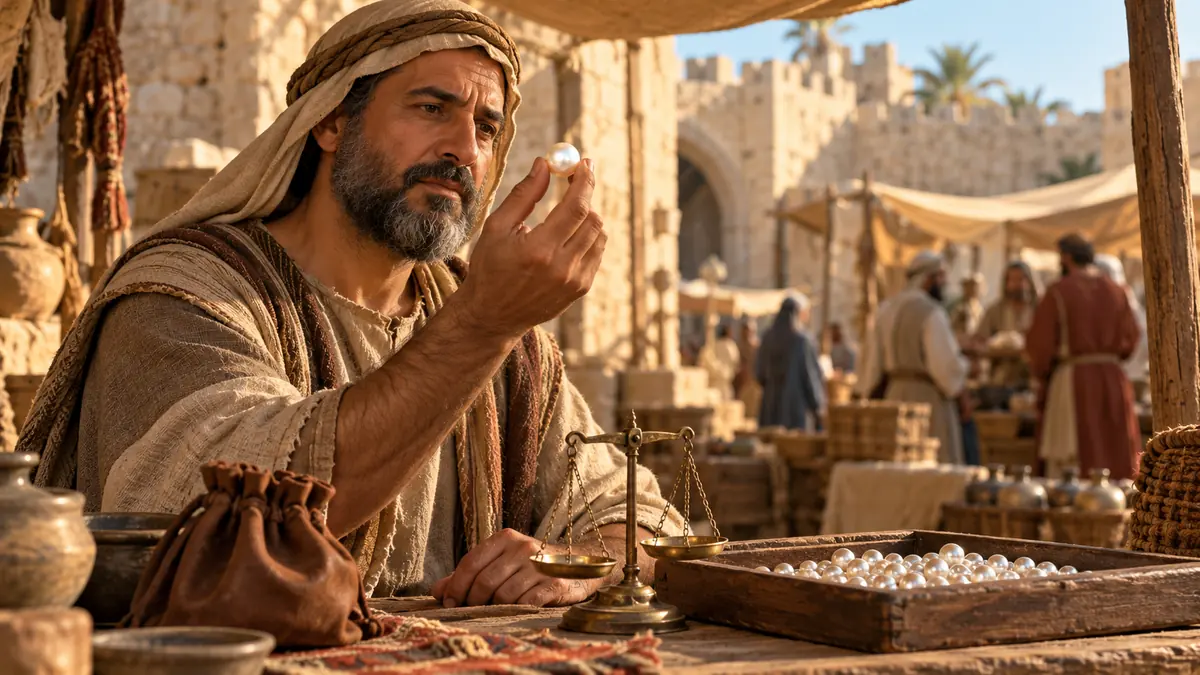
The parable of the pearl of great price is a two-verse story Jesus told in Matthew 13:45-46. A merchant who deals in fine pearls finds “one pearl of great value,” sells everything he has, and buys it. Jesus uses the whole scene to show what “the kingdom of heaven” is like, and Christians differ on whether the merchant stands for a person who finds the kingdom or for Jesus himself.
“Again, the kingdom of heaven is like a merchant in search of fine pearls, who, on finding one pearl of great value, went and sold all that he had and bought it.” (Matthew 13:45-46, ESV)
“The kingdom of heaven” is Matthew’s phrase for God’s rule, the kingdom Jesus announced when he began to preach: “Repent, for the kingdom of heaven is at hand” (Matthew 4:17). Thayer’s lexicon notes the phrase appears “only in Matthew, but very frequently,” and defines the word for kingdom as “royal power, kingship, dominion, rule” (Strong’s 932). The other question readers bring is what it means to “buy” something God gives.
Start each morning in the Word
Get the free 7-day reading plan, then one short devotional each morning.
Where Jesus told it, and to whom
Matthew 13 covers one day of parables. “That same day,” Jesus sits beside the sea, and the crowd grows so large that he teaches from a boat while they stand on the beach (Matthew 13:1-2). Later “he left the crowds and went into the house,” and his disciples asked him to explain the parable of the weeds (Matthew 13:36). The pearl comes after that explanation, so the plainest reading of the sequence is that the disciples heard it indoors.
It is one of a pair. Just before it, a man finds treasure hidden in a field and sells everything to buy the field (Matthew 13:44). Just after it comes a net that gathers “fish of every kind” (Matthew 13:47). Then Jesus asks, “Have you understood all these things?” (Matthew 13:51).
Of the four Gospels, only Matthew has this parable, one of the details that make each Gospel read differently. The same is true of the parable of the ten bridesmaids in Matthew 25. The Gospel of Thomas, a sayings collection outside the Bible, has a version in Saying 76, where a merchant sells his merchandise to buy one pearl (Lambdin translation).
“Great price” or “great value”? The Greek word
The phrase people search for comes from the King James Version. Modern translations mostly say “value.”
| Translation | Matthew 13:46 |
|---|---|
| KJV | ”one pearl of great price” |
| NKJV | ”one pearl of great price” |
| ESV | ”one pearl of great value” |
| NASB | ”one pearl of great value” |
| NLT | ”a pearl of great value” |
| NIV | ”one of great value” |
| CSB | ”one priceless pearl” (footnote: “Or very precious”) |
The Greek word is polytimon, built from polys, “much,” and timē, a word for price or honor (Strong’s 4186 and 5092). Thayer’s lexicon defines it as “very valuable, of great price.” So “price” and “value” are both fair. “Price” keeps the money in the picture, which fits a story that ends with a sale. The differences between the NIV, ESV and KJV often come down to choices like this one.
The verbs carry a detail English hides. In the treasure story, Matthew’s Greek uses the present tense: the man “goes and sells” and “buys” (Matthew 13:44). For the merchant, “sold” is a perfect tense, pepraken. The Expositor’s Greek Testament, an older commentary on the Greek text, says it “points to a momentous step, taken once for all and having lasting effects,” and calls the purchase “a risky speculation.”
Why a pearl would stop his listeners
In the first century, pearls sat at the top of the luxury market. Pliny the Elder, a Roman writer of that century, opened his chapter on them this way: “The first rank then, and the very highest position among all valuables, belongs to the pearl” (Natural History 9.54). He said most came from the Indian Ocean, and the most prized from the Persian Gulf, after crossing “so many seas.”
So the merchant isn’t browsing. Searching for fine pearls is his trade, and he knows what he is looking at when he finds “one pearl of great value.”
A searcher and a finder
The paired stories end the same way but start differently. Matthew says only that the man in the field “found” the treasure, covered it up, and “in his joy” sold all he had (Matthew 13:44). Nothing in the verse says whether he was looking. The merchant, by contrast, was “in search of fine pearls” (Matthew 13:45).
Some readers take that difference to describe two kinds of people: those who come upon God’s kingdom without looking and those who search for it for years. The Expositor’s Greek Testament warns against pressing that: “The difference between seekers and finders must not be exaggerated. The pearl merchant was also a finder.” Matthew mentions joy only in the treasure story. John Chrysostom, preaching on both parables in the late fourth century, said the lesson is to give up everything else “with joy,” knowing “the transaction is gain, and not loss” (Homily 47 on Matthew).
Who is the merchant? Two readings
Christians have read this parable two main ways. Both sit comfortably within historic Christian belief, and the text itself doesn’t settle the question.
The merchant is a person who finds the kingdom. The pearl is the gospel, the kingdom, or Christ himself, and the merchant is anyone who sees its worth and lets go of what stands in the way. Matthew Henry’s commentary reads it this way: “Jesus Christ is a Pearl of great price.” So does Albert Barnes, who says it represents “the gospel as of more value than all other things.” The 18th-century Baptist John Gill called it “the more common interpretation.” Paul uses similar language in Philippians 3:8: “I count everything as loss because of the surpassing worth of knowing Christ Jesus my Lord.”
The merchant is Jesus, and the pearl is his people. In this reading Jesus does the searching, as he says in Luke 19:10: “For the Son of Man came to seek and to save the lost.” He gives up everything, including his life, to buy the pearl. John Gill set out this view as possible, describing Christ as one who “made a purchase of them, with the price of his own blood,” which echoes Paul’s “you were bought with a price” (1 Corinthians 6:20). A current Bible Study Tools article by Peyton Garland offers both readings side by side.
Gill also gave the main objections to the second reading. The merchant seeks “goodly pearls,” any good ones, which fits a person shopping better than Christ seeking his people. And Gill says people have no “intrinsic excellency in them” that would make them pearls, “but by his grace.”
Some versions of the second reading add a picture from biology. A 2019 post on the No Longer Lukewarm blog says a pearl forms around “an irritant” that injures the oyster, and reads that as Christ transforming his people. That picture depends on modern knowledge. Pliny, writing in the same century as Jesus, recorded a different belief: that the shellfish “receives a kind of dew” that forms the pearl.
Does the parable mean you can buy your way in?
If salvation is a gift, why does the merchant pay?
The picture in this parable is about the pearl’s worth and what the merchant does once he sees it. Scripture also uses buying language for things no one can pay for. Isaiah 55:1 calls the thirsty: “he who has no money, come, buy and eat!” and adds, “without money and without price.” Paul says it outright: “by grace you have been saved through faith. And this is not your own doing; it is the gift of God, not a result of works” (Ephesians 2:8-9). The ESV’s cross references for Matthew 13:46 point to both Isaiah 55:1 and Philippians 3:7-8.
Jesus does say that following him costs everything: “any one of you who does not renounce all that he has cannot be my disciple” (Luke 14:33). The order in the parable is worth noticing, though. The merchant sees the pearl’s worth before he sells anything. Read that way, letting go follows seeing what matters most. It doesn’t earn the right to see it. Augustine made a related point: we give ourselves for the pearl “not because we are of equal value to that, but because we cannot give any thing more.”
How the early church read it
Early readers didn’t agree on every detail either. Thomas Aquinas gathered their comments in his Catena Aurea, a chain of quotations on the Gospels.
- John Chrysostom took the pearl as the gospel, and noted that a pearl is small enough to hide in your hand: its owner knows he is rich while others can’t tell.
- Jerome took the many “goodly pearls” as the Law and the Prophets, and the one pearl as knowing the Savior and his passion and resurrection.
- Gregory the Great called it “the sweetness of the heavenly kingdom.”
- Augustine offered three options: Christ, love of neighbor, or the Word. Whichever it is, he said, we are not free to have it unless we let go of what this world offers.
Questions people ask
What is the main lesson of the parable of the pearl? Something of surpassing worth is found, and the one who finds it gives up everything to have it. Commentators such as Matthew Henry and Albert Barnes take the merchant as a person and the pearl as the gospel or Christ, the reading John Gill called “the more common interpretation.” Others take the merchant as Jesus and the pearl as his people.
What is the difference between the hidden treasure and the pearl? Matthew 13:44 says only that a man found treasure in a field, without saying whether he was looking. The merchant in Matthew 13:45-46 was searching for fine pearls. Both sell everything to buy what they found.
Is the Pearl of Great Price a Mormon book? Yes, that is a separate thing with the same name. The Pearl of Great Price is a collection that The Church of Jesus Christ of Latter-day Saints made one of its standard works in 1880. It is not part of the Bible used by Catholic, Orthodox or Protestant churches. The parable in Matthew 13 is.
Read the whole run together
Open your Bible to Matthew 13:44-52 and read the treasure, the pearl and the net in one sitting, then the question Jesus asks at the end. For a short reflection on these two verses, the site’s devotional on Matthew 13:45-46 is a good next stop. For another parable Christians read in more than one way, see the parable of the prodigal son.
Scripture quotations are from the ESV unless another translation is named. The Greek is from the SBL Greek New Testament, and word definitions are from Strong’s concordance and Thayer’s lexicon on Bible Hub.