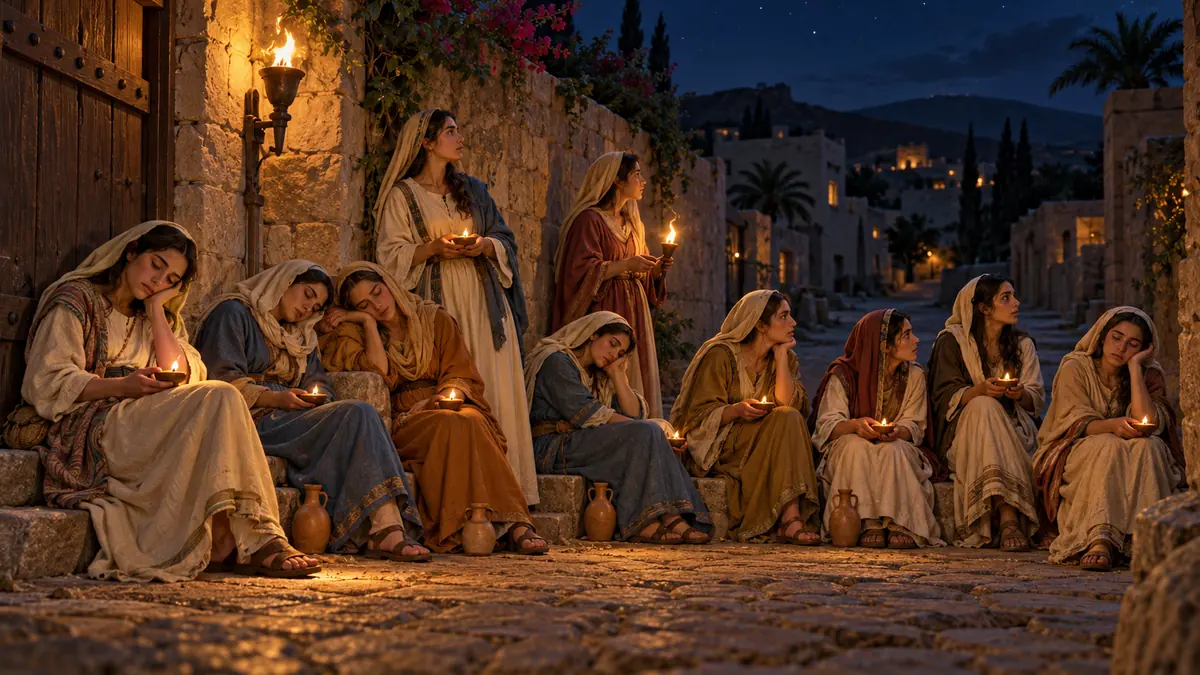
The parable of the ten bridesmaids, also called the parable of the ten virgins, is a parable, a short story Jesus told to teach a point, about being ready for his return, even if it comes later than anyone expects. Jesus gives the point himself in the last line: “Watch therefore, for you know neither the day nor the hour” (Matthew 25:13, ESV). Christians agree on that point and differ on the details, mainly on what the oil stands for.
The story is in Matthew 25:1-13. Jesus tells it on the Mount of Olives, as part of his answer when his disciples ask about his coming.
Start each morning in the Word
Get the free 7-day reading plan, then one short devotional each morning.
The story Jesus told, in Matthew 25:1-13
Here is the whole parable in the ESV:
“Then the kingdom of heaven will be like ten virgins who took their lamps and went to meet the bridegroom. Five of them were foolish, and five were wise. For when the foolish took their lamps, they took no oil with them, but the wise took flasks of oil with their lamps. As the bridegroom was delayed, they all became drowsy and slept. But at midnight there was a cry, ‘Here is the bridegroom! Come out to meet him.’ Then all those virgins rose and trimmed their lamps. And the foolish said to the wise, ‘Give us some of your oil, for our lamps are going out.’ But the wise answered, saying, ‘Since there will not be enough for us and for you, go rather to the dealers and buy for yourselves.’ And while they were going to buy, the bridegroom came, and those who were ready went in with him to the marriage feast, and the door was shut. Afterward the other virgins came also, saying, ‘Lord, lord, open to us.’ But he answered, ‘Truly, I say to you, I do not know you.’ Watch therefore, for you know neither the day nor the hour.” (Matthew 25:1-13, ESV)
The scene is a wedding at night. Ten young women go out to meet the groom. He is delayed, they all doze off, and at midnight someone shouts that he is coming. The lamps now need to burn, and five of the women brought no oil to refill them. They go to buy some, the groom arrives while they are gone, and the door is shut.
Bridesmaids, virgins or young women? What the translations say
The Greek word in verse 1 is parthenos, which Thayer’s lexicon defines as “a virgin” (Strong’s 3933). English Bibles render it in three ways. Here is how common versions word Matthew 25:1, with their own footnotes (text from Bible Gateway).
| Translation | Wording in Matthew 25:1 | Its own footnote |
|---|---|---|
| ESV | ”ten virgins" | "lamps”: “Or torches” |
| NIV, KJV, NASB | ”ten virgins” | none on the word |
| CSB | ”ten virgins" | "Or bridesmaids”; “lamps”: “Or torches” |
| NLT | ”ten bridesmaids" | "Or virgins” |
| CEB | ”ten young bridesmaids” | none on the word |
| NRSVUE | ”Ten young women" | "Gk virgins” |
So “bridesmaids” is a translation choice, made by the NLT and CEB, and it is where the common search phrase comes from. It’s the same ten women in every version.
The picture of bridesmaids may not fit exactly. Dean Wenthe, writing in The Springfielder in January 1976, says it is “improbable that we should regard them as bridesmaids for then they would be expected to stay with the bride.” He prefers F. C. Burkitt’s suggestion that they were “friends or neighbors of the couple who go out to meet the bridegroom’s procession.”
The lamps are debated too. Thayer lists Matthew 25 under the sense “a lamp, the flame of which is fed with oil” (Strong’s 2985). Albert Barnes thought they “were rather ‘torches,’” made by winding rags on a handle and dipping them in oil. The Pulpit Commentary, following Alfred Edersheim, says they “were not torches” but small oil cups carried on poles. Either way, the flame needed oil to keep going.
What the lamp represents is a separate question, and the parable doesn’t say. Ellicott calls it “the outward life of holiness,” Augustine reads the lamps as good works, and Gill as “an external profession of religion.” Wenthe treats the lamps as part of the story and nothing more.
What “trimmed their lamps” means
When the cry goes up, all ten “rose and trimmed their lamps” (Matthew 25:7). The verb is kosmeō, and Thayer gives “to put in order, arrange, make ready,” citing this verse (Strong’s 2885). Barnes describes the work as “removing the burnt parts of the linen or the torch, so that they would burn clear,” then adding oil. That’s the moment the foolish five find they have nothing to add.
Where it sits in Matthew 24-25
This parable is part of a long answer. In Matthew 24, Jesus sits on the Mount of Olives and his disciples ask, “what will be the sign of your coming and of the end of the age?” (Matthew 24:3). He tells them, “concerning that day and hour no one knows” (Matthew 24:36), and, “you also must be ready, for the Son of Man is coming at an hour you do not expect” (Matthew 24:44).
The ten bridesmaids pick up that thread. Right after it comes the parable of the talents, which begins “For it will be like a man going on a journey” (Matthew 25:14), and then the sheep and the goats (Matthew 25:31-46).
Jesus calls himself the bridegroom earlier in Matthew, when he asks whether the wedding guests can mourn “as long as the bridegroom is with them” (Matthew 9:15). That’s why Barnes, who calls the bridegroom “the Lord Jesus Christ,” and GotQuestions read the groom as Jesus. Wenthe adds a caution: the parable itself never names him, and the link comes from passages like Matthew 9:15.
All ten fell asleep
The wise women slept too. Verse 5 says “they all became drowsy and slept,” and the parable never blames anyone for it. The two groups differ only in the oil they brought.
Readers explain the delay in different ways. Wenthe treats it as stage-setting and writes, “Without the delay, all would have had sufficient oil!” Barnes and Jack Crabtree, in a 2001 Gutenberg College essay, go further and say the wise expected a wait might come. Barnes writes that the foolish “probably expected that the bridegroom would come immediately.” Augustine, preaching on this parable, read the sleep itself as death, “another sleep which no one escapes,” and the midnight rising as the resurrection.
In none of these readings is the sleep itself the failure. If you’ve read this parable and worried that you’re the foolish one, notice that everyone in it falls asleep. Lamentations speaks of a quieter, patient kind of waiting for God: “It is good that one should wait quietly for the salvation of the LORD” (Lamentations 3:26, ESV).
What does the oil stand for? Five readings
Jesus explains a few parables, like the sower and the weeds in Matthew 13, and leaves others, like the pearl of great price, unexplained. He never explains the oil, and Christian writers have read it in at least five ways.
| Reading | Who holds it, in their words | Why the wise couldn’t share |
|---|---|---|
| The Holy Spirit, or the grace he gives | Ellicott: “the divine grace, or more definitely, the gift of the Holy Spirit.” Gill and GotQuestions read it the same way. | No one can give another person the Spirit |
| Love, carried inwardly | Augustine, Sermon 93 (Sermon 43 on the New Testament in the Schaff edition): “Do you think that it is not charity?” He put good works in the lamps and love in the oil. | Love and a clear conscience live inside a person |
| Good deeds | A 2024 Notre Dame daily reflection: the oil “symbolizes their good deeds.” Wenthe notes K. P. Donfried (1974) took the oil as good works. | Deeds can’t be handed over at the last minute |
| An inner reality, such as faith or desire for the kingdom | Regis Martin in the National Catholic Register (2022): the oil “is not detachable from those who possess it.” Crabtree: “our desire for, belief in, and commitment to the eternal Life.” | It belongs to the person who has it |
| A story detail, not a symbol | Wenthe: lamps and oil are “the simple components of the story and no more.” | There really wasn’t enough to go around |
Why wouldn’t the wise bridesmaids share?
Refusing to share can sound unkind. The parable gives the women’s own reason: “there will not be enough for us and for you” (Matthew 25:9). On the plain story level, splitting the oil could have left all ten lamps out before the procession reached the feast.
Read as a picture of something spiritual, the refusal says more. The Notre Dame reflection says the wise “refuse to share their oil not because they are selfish but because they can’t distribute their good deeds.” Martin and Ellicott reach the same place from different readings: the thing the oil stands for can’t be lent.
”I do not know you” and the shut door
The ending is the hardest part. The other women return, call out “Lord, lord, open to us,” and hear “I do not know you” (Matthew 25:11-12). Jesus uses close wording elsewhere. In Luke 13:25 a master shuts the door and tells those knocking, “I do not know where you come from.” In Matthew 7:21 he warns, “Not everyone who says to me, ‘Lord, Lord,’ will enter the kingdom of heaven.”
Christians read the ending in light of bigger questions the parable doesn’t settle. GotQuestions notes that some see a rapture of the church here, and it applies the parable to Christ’s second coming and to Israel. Readers also disagree on whether the five were ever true believers, a question tied to whether salvation can be lost. Barnes saw them as people “who profess to love him, but are destitute of true grace.” Augustine counted both groups among souls that “have the Catholic faith, and seem to have good works.” The parable doesn’t settle it. What it says plainly is that a time comes when the door is shut, and the time to get ready is before then.
Questions people ask
What does the oil represent in the parable of the ten bridesmaids? The parable never says. Ellicott and GotQuestions read the oil as the Holy Spirit, Augustine as love (charity), a 2024 Notre Dame reflection as good deeds, and Dean Wenthe as a plain story detail. Four of those five readings treat it as something one person can’t lend another.
Who is the bridegroom in the parable of the ten bridesmaids? Interpreters such as Albert Barnes and GotQuestions read the bridegroom as Jesus, though Matthew 25 never names him. Earlier in Matthew he calls himself the bridegroom (Matthew 9:15), and the parable ends with a warning about his coming: “you know neither the day nor the hour” (Matthew 25:13, ESV).
What does the lamp represent in the parable of the ten virgins? The parable doesn’t say. Ellicott reads the lamp as “the outward life of holiness,” Augustine as good works, and John Gill as “an external profession of religion”. Dean Wenthe treats lamps and oil as plain parts of the story.
Does the Bible give the names of the ten virgins? No. Matthew 25:1-13 gives no names, ages or families for the ten. It only sorts them into five foolish and five wise by whether they brought extra oil.
What does “trimmed their lamps” mean in Matthew 25:7? The Greek verb kosmeō means “to put in order, arrange, make ready” (Thayer). Albert Barnes describes trimming as clearing away the burnt part of the linen or torch so it would burn clear, then adding oil.
How is the parable of the ten bridesmaids related to the parable of the talents? The talents comes right after it, starting at Matthew 25:14. Both are part of Jesus’ answer to his disciples about his coming (Matthew 24:3). The bridesmaids stress being ready; the talents stress being faithful with what you’ve been given while you wait.
Read it in its setting
Read Matthew 24:36 through 25:13 in one sitting. Jesus says no one knows the hour (24:36), tells his disciples to be ready (24:44), and then tells a story about a groom who comes later than anyone planned.