“Therefore the Lord himself will give you a sign. Behold, the virgin shall conceive and bear a son, and shall call his name Immanuel” (Isaiah 7:14, ESV).
Immanuel, also spelled Emmanuel, means “God with us.” It’s a Hebrew name made of immanu (“with us”) and El (“God”); the Brown-Driver-Briggs lexicon glosses it “with us is God” (Bible Hub, Hebrew 6005). The name appears in Isaiah 7:14, Isaiah 8:8 and Matthew 1:23. Immanuel is the spelling from Isaiah’s Hebrew; Emmanuel comes from the Greek of Matthew, and the King James Version uses it there. Isaiah first spoke it to Ahaz, a terrified king who had just refused to ask God for a sign.
Start each morning in the Word
Get the free 7-day reading plan, then one short devotional each morning.
A king shaking like a tree in the wind
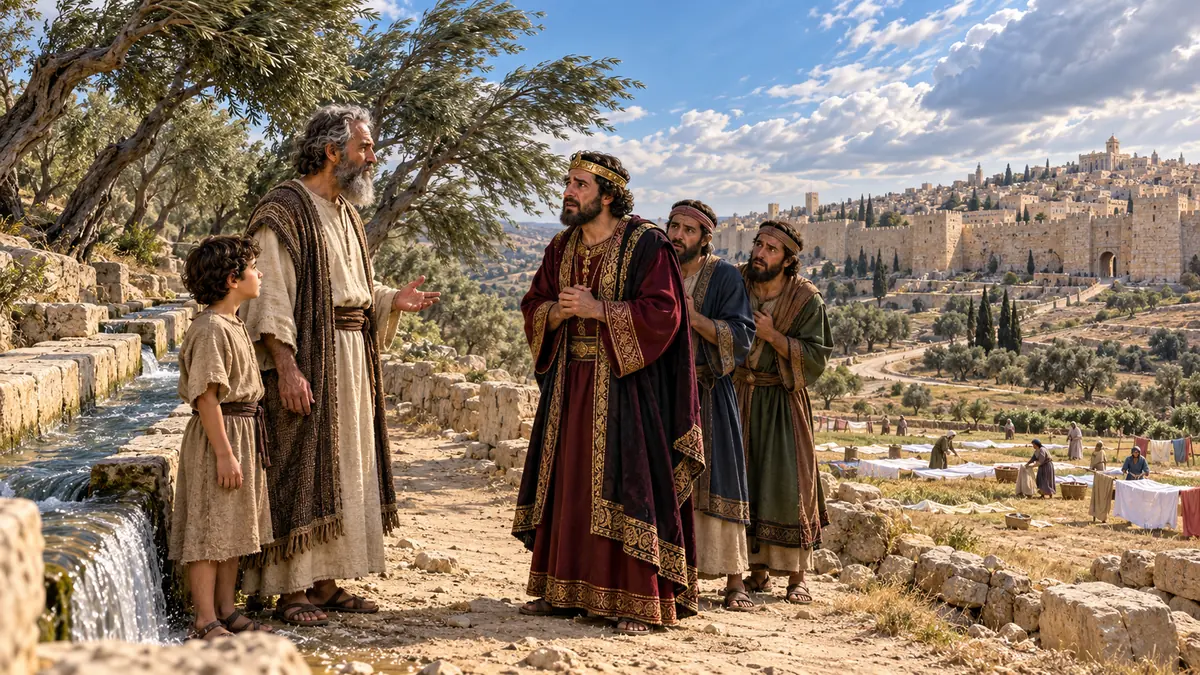
The king was Ahaz of Judah. Rezin of Syria and Pekah of Israel “came up to Jerusalem to wage war against it, but could not yet mount an attack against it” (Isaiah 7:1). The hearts of Ahaz and his people “shook as the trees of the forest shake before the wind” (Isaiah 7:2). The two kings planned to conquer Judah and “set up the son of Tabeel as king in the midst of it” (Isaiah 7:6).
God sent Isaiah to meet Ahaz “at the end of the conduit of the upper pool,” with his son Shear-jashub (“A remnant shall return,” per the ESV footnote), and the message was blunt: this plan “shall not stand” (Isaiah 7:3, 7).
Then God offered Ahaz a sign, “deep as Sheol or high as heaven” (Isaiah 7:11). Ahaz turned it down: “I will not ask, and I will not put the LORD to the test” (Isaiah 7:12). Isaiah answered the whole “house of David” and said the Lord would give a sign anyway. The ESV footnote points out that “the Hebrew for you is plural in verses 9, 13, 14.”
Isaiah 7:16 gives the sign a time limit: “before the boy knows how to refuse the evil and choose the good, the land whose two kings you dread will be deserted” (Isaiah 7:16). The threat would be gone before this child was old enough to tell right from wrong.
The name comes back in Isaiah 8
In the next chapter, Isaiah warns that Assyria, the empire behind the city of Nineveh, will flood into Judah and fill “the breadth of your land, O Immanuel” (Isaiah 8:8). Then he turns to the nations: “speak a word, but it will not stand, for God is with us” (Isaiah 8:10), where the ESV footnote says the Hebrew for “God is with us” is Immanuel. Brown-Driver-Briggs calls these two uses a “declaration of trust and confidence.” Here the name works as a defiant cry from a small, frightened nation.
Why some Bibles say “virgin” and others “young woman”
Open a few translations of Isaiah 7:14 and you’ll see the split:
| Translation | Isaiah 7:14 |
|---|---|
| ESV | ”the virgin shall conceive and bear a son” |
| NIV | ”The virgin will conceive and give birth to a son” |
| KJV | ”a virgin shall conceive, and bear a son” |
| NRSVUE | ”the young woman is with child and shall bear a son” |
| NET | ”this young woman is about to conceive” |
The Hebrew word is almah. Brown-Driver-Briggs defines it as “young woman,” either a “maid or newly married,” while the NAS Exhaustive Concordance gives “a young woman, a virgin” (Bible Hub, Hebrew 5959). The word Brown-Driver-Briggs defines simply as “virgin” is a different one, betulah (Hebrew 1330).
The ESV itself shows the range. It renders almah “the girl” for Moses’ sister (Exodus 2:8) and “virgin” in Genesis 24:43, of the young woman Abraham’s servant hopes to meet at the well, who turns out to be Rebekah, “a maiden whom no man had known” (Genesis 24:16). So almah points first to age and stage of life. Whether it also carries the idea of virginity in Isaiah 7:14 is what people debate.
Greek translations sharpened the question. The Septuagint, the ancient Greek translation of the Hebrew Scriptures, renders the word parthenos. Thayer’s Greek lexicon defines parthenos first as “a virgin,” but notes that the Septuagint uses it for almah only twice, in Genesis 24:43 and Isaiah 7:14 (Bible Hub, Greek 3933), so the Greek word alone doesn’t settle what Isaiah’s Hebrew meant. The Cambridge Bible on Isaiah 7 notes that “the post-Christian Greek versions of Aquila, Theodotion and Symmachus agree in rendering the word by νεᾶνις” (neanis, “young woman”). Matthew quotes Isaiah with parthenos.
Albert Barnes, who keeps “virgin,” argues from context that the passage “requires us to understand it of one who was ‘not then married’” (Barnes on Isaiah 7). Choices like this are part of why Bible translations differ at all.
How Matthew uses it
Matthew tells Jesus’ birth from Joseph’s side, while Luke tells it from Mary’s (see where the Christmas story is in the Bible). Before Mary and Joseph “came together she was found to be with child from the Holy Spirit,” and an angel tells Joseph, “you shall call his name Jesus, for he will save his people from their sins” (Matthew 1:18-21). Matthew then writes, “All this took place to fulfill what the Lord had spoken by the prophet,” quotes Isaiah 7:14, and explains that Immanuel “means, God with us” (Matthew 1:22-23). It’s one of the clearest cross references in the Bible: a New Testament writer quoting an Old Testament verse and crediting it to “the prophet.”
Nobody in Matthew names the baby Immanuel. Joseph “called his name Jesus” (Matthew 1:25), so for Matthew, Immanuel describes who Jesus is rather than giving his name. The naming verb changes too. Isaiah’s Hebrew verb is tagged “and she will call” in the interlinear, while Matthew’s Greek kalesousin is “they will call” (Matthew 1:23 interlinear). The next chapter brings the wise men from the east, and Herod’s scholars answer them with another prophet, Micah, who points to Bethlehem.
Matthew bookends his Gospel with the idea, ending on Jesus’ words “I am with you always, to the end of the age” (Matthew 28:20). Christians read “God with us” in the fullest sense, as the incarnation: “the Word became flesh and dwelt among us” (John 1:14), and the Nicene Creed confesses that Christ “became incarnate by the Holy Spirit and the virgin Mary.” Ahaz himself even appears in Jesus’ family line in Matthew 1:9.
The main ways people read Isaiah 7:14
Readers agree on what the name means. They differ on how Isaiah’s sign and Matthew’s quotation fit together. The Pulpit Commentary on Isaiah 7 sums up the three questions people still ask: were the mother and son people of Isaiah’s own time, were they Mary and Jesus, or “had the prophecy a double fulfillment”?
A near sign and a far fulfillment
Barnes held that Isaiah first meant a child born in Ahaz’s day, as a pledge that Judah would be safe, and that his words also reached to the Messiah: “the twofold reference is clear.”
The child as the Messiah
John Gill rejected each candidate from Ahaz’s day, including Hezekiah and a son of Isaiah, and concluded that “the Messiah is here meant” (Gill on Isaiah 7). Keil and Delitzsch also held that “the child who was to be born was the Messiah” (Keil and Delitzsch on Isaiah 7).
A sign for Ahaz’s own day
Rashi and Radak, two medieval Jewish commentators, read the sign as a birth in Ahaz’s own time. Rashi comments on “the young woman”: “My wife will conceive this year” (Rashi on Isaiah 7:14, Sefaria), meaning Isaiah’s wife. Radak weighs Isaiah’s wife or Ahaz’s and favors Ahaz’s (Radak on Isaiah 7:14). A modern Jewish explanation on Aish.com takes almah as “a young woman without reference to her virginity” and sets out its reading of Isaiah 7:14 in full.
For a mother in Ahaz’s day, the Cambridge Bible lists the guesses: Isaiah’s wife (some identify the child with Maher-shalal-hash-baz, whose birth carries a similar deadline in Isaiah 8:3-4), a young woman in Ahaz’s household, or one standing nearby. Hezekiah is ruled out; by 2 Kings 16:2 and 18:2, the Pulpit Commentary reckons he “was at least nine years old in the first year of Ahaz.” The text itself doesn’t name the child.
What holds under every reading is the meaning of the name. Matthew’s own account is plain too: he presents Jesus as conceived “from the Holy Spirit” before Mary and Joseph came together, and the Apostles’ Creed confesses that he was “born of the virgin Mary.”
Immanuel or Emmanuel?
Both are right. Emmanuel follows the Greek Emmanouēl in Matthew, as the King James Version prints it: “they shall call his name Emmanuel, which being interpreted is, God with us” (Matthew 1:23, KJV). The ESV uses Immanuel in both places. The Advent hymn “O Come, O Come, Emmanuel” uses the E spelling.
Questions people ask
Who is Immanuel in the Bible?
In Isaiah 7:14, Immanuel is a child promised as a sign to King Ahaz when Syria and Israel threatened Jerusalem. Matthew 1:23 applies the name to Jesus, explaining that it “means, God with us.”
Was Immanuel Jesus’ actual name?
No. The angel tells Joseph to name the child Jesus, and Joseph “called his name Jesus” (Matthew 1:21, 25). Matthew uses Immanuel as a title that says who Jesus is.
What “God with us” meant to people who were afraid
Ahaz had real reasons to be scared. Two armies were coming, and he shook like a tree in the wind. God answered that fear with a child and a name. Later in the same book, God says it again to his people in Isaiah 41:10: “fear not, for I am with you.”
Read Isaiah 7:1-16 and then Matthew 1:18-25, side by side. The first shows a frightened king who wouldn’t ask for a sign. The second shows how Matthew heard that old name in the birth of Jesus.