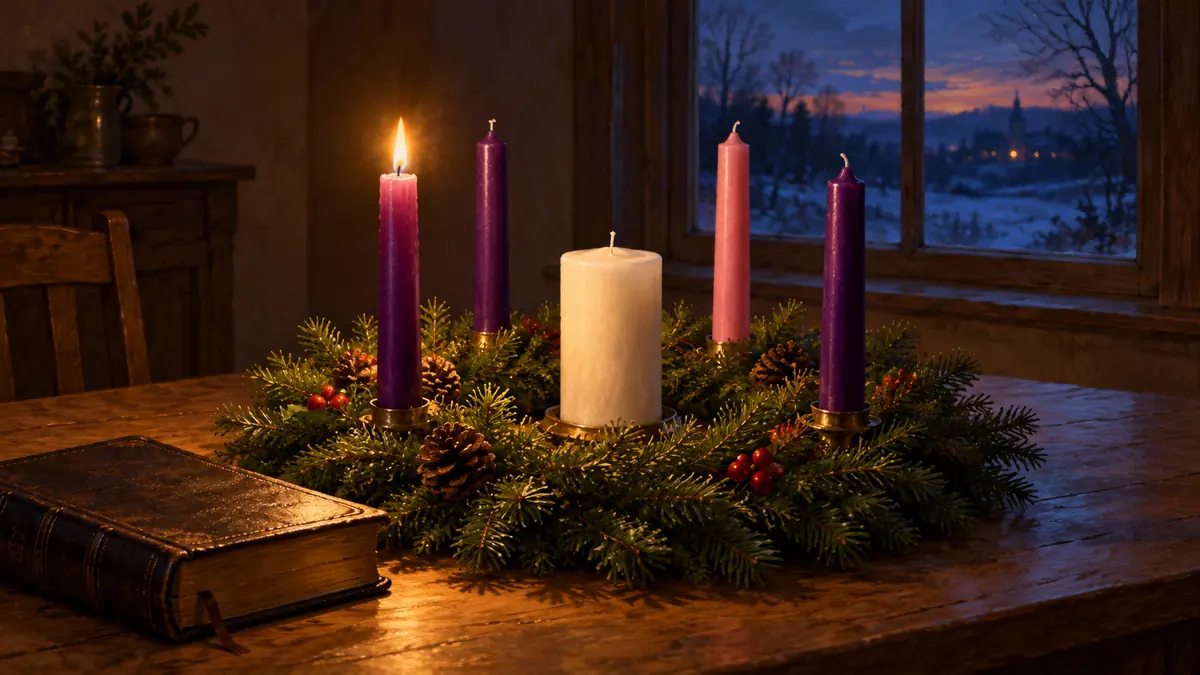
The four candles on an Advent wreath count down the four Sundays before Christmas, with one more lit each week, and in many churches they stand for hope, peace, joy and love. In the most common pattern, three are purple and the pink one, lit third, is for joy. Some wreaths add a white Christ candle in the center for Christmas Eve or Christmas Day.
None of that comes from the Bible. The wreath is a church custom: the first well-documented one was lit in Hamburg in 1839, and the United Methodist Church says the weekly theme names came from church supply houses in the mid-1900s. That history is why your church’s wreath may not match your neighbor’s.
Start each morning in the Word
Get the free 7-day reading plan, then one short devotional each morning.
The four Advent candles in order
| Week | Usual color | Common theme | Another common name | A reading to pair with it |
|---|---|---|---|---|
| 1 | Purple | Hope | Prophecy candle | Isaiah 9:2 |
| 2 | Purple | Peace | Bethlehem candle | Isaiah 9:6 |
| 3 | Pink | Joy | Shepherd’s candle | Philippians 4:4 |
| 4 | Purple | Love | Angel’s candle | John 3:16 |
| Christmas | White (center) | Christ | Christ candle | John 8:12 |
The themes and names follow the common Catholic pattern used by Dynamic Catholic and Hallow. The readings are suggestions, not an official list. Order, names and colors all vary from church to church, as the sections below show.
The Bible never mentions an Advent wreath
You won’t find a wreath, a candle schedule, or the word “Advent” in Scripture. The Catholic Encyclopedia traces the word to the Latin ad-venio, “to come to,” and Advent names the weeks churches set aside to get ready for Christmas. The wreath came along much later.
What the candles point to is in the Bible. The idea is light growing in the dark, one more flame each week. Isaiah put that picture into words: “The people who walked in darkness have seen a great light; those who dwelt in a land of deep darkness, on them has light shone” (Isaiah 9:2, ESV). Matthew’s Gospel quotes these lines when Jesus begins preaching in Galilee (Matthew 4:14-16), and the U.S. Catholic bishops’ wreath blessing lists Isaiah 9 among its readings. Two chapters earlier, Isaiah gives the sign of a child called Immanuel, “God with us” (Isaiah 7:14), and what that name means is a short read of its own.
The candles also look in two directions. The U.S. Catholic bishops say the lighting expresses hope for Christ’s coming at Christmas and anticipation of his second coming at the end of time. Romans 13:12 looks ahead the same way: “The night is far gone; the day is at hand.”
The first wreath had a candle for every day
The Advent wreath most people know traces back to Johann Hinrich Wichern, a Lutheran pastor who ran the Rauhes Haus, or “Rough House,” a home for poor children in Hamburg. Historian Kathleen Manning, writing in U.S. Catholic, says the boys kept asking him when Christmas would come. A history by Bjoern Smertka of the Hamburg Historical Museums Foundation records the answer: in 1839 a wooden wreath about the size of a wagon wheel was lit in the home’s prayer room. It held red candles for ordinary days and white ones for the Sundays (Manning describes small red and large white candles), and one more was lit each day until all of them burned on Christmas Eve.
Accounts give different candle counts, and the Hamburg history explains why. The number of red candles changed from year to year, anywhere from 18 to 24, because Advent isn’t a fixed length. It starts on the fourth Sunday before Christmas, so by our count it runs from 22 to 28 days through Christmas Eve, depending on the weekday Christmas falls on.
According to the same Hamburg history, fir branches were added from 1860, and the wreath later shrank to just the four Sunday candles so families could bring it into their living rooms. Manning adds that later German Christians used four red candles, and that Catholics switched to three purple and one pink to match the colors priests wear. The Hamburg history, published in 2017, says the Rauhes Haus still lights a full Wichern wreath each year.
You’ll also read that the wreath goes back to pre-Christian winter customs or Scandinavian candle wheels, and the United Methodist Church’s FAQ calls it a German and Scandinavian home practice at first. None of these sources documents an earlier wreath the way the Hamburg history documents Wichern’s.
Why one candle is pink
Purple matches the season. The Catholic Encyclopedia notes that priests wear violet in Advent, with rose allowed on the third Sunday, and Manning calls purple the color “typically associated with penance.” Christianity.com also reads it as a royal color, a welcome for a coming king.
The pink (rose) candle belongs to the third Sunday, called Gaudete Sunday. In the Catholic Mass, that Sunday’s entrance antiphon is taken from Philippians 4:4-5 and begins, “Rejoice in the Lord always.” In the ESV the two verses read: “Rejoice in the Lord always; again I will say, rejoice. Let your reasonableness be known to everyone. The Lord is at hand; …” So the third Sunday, partway through a season of waiting, is set aside for joy.
What “rejoice” and “at hand” translate
Paul wrote in Greek, and his word for “rejoice” is chairete. The Latin Vulgate renders it Gaudete in Domino semper, “Rejoice in the Lord always,” and that first Latin word gave the Sunday its name.
The next line is where English Bibles differ a little. The ESV says “The Lord is at hand,” and the NIV says “The Lord is near.” The Greek word, engys, can mean near in place or near in time. Thayer’s Greek Lexicon lists this verse under nearness in time, reading it as Christ’s return, and notes the same phrase can describe God’s closeness, as in “The LORD is near to all who call on him” (Psalm 145:18, ESV). One reading looks ahead to Christ’s return; the other points to God’s nearness now.
Names, order and colors change from church to church
The theme names are younger than they look. The United Methodist FAQ explains that by the mid-1900s, church supply houses selling wreaths for public worship assigned a theme to each week, based on the readings of that era, and lists them as “Hope, Love, Joy, and Peace, in that order.” It adds that most churches now follow different reading cycles, so the themes don’t always match the Sunday Scriptures, except for the third Sunday’s joy.
So the hope, peace, joy, love order in the table isn’t universal. Dynamic Catholic and Hallow also give the weeks the Prophecy, Bethlehem, Shepherd’s and Angel’s names, and the U.S. Catholic bishops’ own description of the wreath assigns no names at all.
Colors vary too. Manning reported in 2015 that Missouri Synod Lutherans use pink and purple, the Evangelical Lutheran Church in America teaches four blue candles as a sign of hope, and Moravians use four plain beeswax candles. The Methodist FAQ says church wreath candles are usually purple or blue, to match the season’s cloth hangings. The Hamburg history describes today’s German wreath with four red candles, and Manning notes that photos from 2006 showed Pope Benedict XVI’s office wreath with four red candles.
The evergreens and the circle carry meaning by custom, not Scripture: Christianity.com, for example, reads the circle as God’s unending love and the evergreens as the life and hope Christ brings.
The white candle in the middle is optional
The center candle, usually white and larger, is called the Christ candle. Dynamic Catholic says it is sometimes lit on Christmas Eve or Christmas Day to show that Jesus is with us. Jesus called himself “the light of the world” (John 8:12, ESV), and John opens his Gospel with the line that the light shines in the darkness, and the darkness has not overcome it (John 1:5).
Not every church wants one. A Lutheran handbook, The Altar Guild Manual (Concordia, 2008), as quoted in Wikipedia’s article on the Advent wreath, discourages the Christ candle because it borrows from the Easter candle, and says the wreath belongs to the waiting season and should come down at Christmas.
How to light an Advent wreath at home
Start on the first Sunday of Advent with one purple candle. In 2026 the four Sundays fall on November 29, December 6, December 13 (the pink candle) and December 20, and Christmas is on a Friday. Each week, light the candles from the weeks before, then the new one. The arrangement is flexible: the Methodist FAQ notes that in the old home practice, a line or a circle worked equally well. Go around in either direction, as long as the pink candle comes up third.
Keep it short. The U.S. Catholic bishops publish a household blessing for the wreath for the first Sunday or the evening before, led by a parent or another family member: a reading from Isaiah 9, 63 or 64, then a short prayer. On the other weeks, read the verse from the table, pray briefly, and blow the candles out. Some families also keep a short daily devotional reading going between Sundays.
If you light just one candle this year, read Isaiah 9:1-7 out loud before you strike the match.
Common questions about Advent candles
What order do you light the Advent candles in?
On a wreath with three purple candles and one pink, light a purple candle the first Sunday, a second purple the second Sunday, the pink candle the third Sunday and the last purple the fourth Sunday, relighting the earlier ones each time. A white center candle, where churches use one, is usually lit on Christmas Eve or Christmas Day. Twelve days after Christmas comes Epiphany on January 6, the feast Western churches came to tie to the wise men’s visit. Themes attached to each week vary by church.
Why is one Advent candle pink and three purple?
In churches that use these colors, purple matches the violet of the Advent season, a color tied to penance, and the pink (rose) candle marks Gaudete Sunday, the third Sunday. Gaudete is the Latin for “rejoice” in Philippians 4:4. Some churches use blue, red or plain beeswax candles instead.
Do you need a white candle in the middle?
No. The basic wreath has four candles, and the center Christ candle is an optional addition that some Lutheran guidance discourages.
What color do you wear on the first Sunday of Advent?
For clergy and the church itself, the season sets the color. Catholic priests wear violet in Advent, according to the Catholic Encyclopedia, and the United Methodist FAQ says church candles and cloth hangings are usually purple or blue. None of the sources here sets a dress color for the congregation.